Super Bionic Bash
Limbitless Solutions
Game Programmer Assistant Scholar
May 2025 - Current

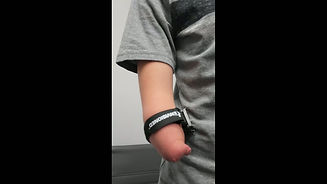
Limbitless Solutions is a nonprofit research initiative at the University of Central Florida that brings together artists, engineers, clinicians, and students to create empowering technology for children with limb differences.
Image and video courtesy of Limbitless Solution, All rights reserved
Project Details
-
Unreal 5.6
-
6 person team
-
Currently in development
Game Overview
As part of this interdisciplinary work and funded by an EPIC Unreal Megagrant, we developed a multiplayer party game in Unreal Engine to support the training and adoption of bionic prosthetic arms.
The game allows up to four players to participate in a series of fast-paced minigames. Players can use a traditional game controller or an electromyographic (EMG) controller, which reads muscle signals using the same technology found in the bionic arms distributed by Limbitless Solutions to children with upper limb differences.
Designed as a team project, the game creates a gamified training environment where children learning to use their bionic arms can strengthen the muscles required for control while playing alongside friends and family. This approach turns rehabilitation and skill-building into a social, engaging experience that reinforces confidence, inclusion, and the everyday use of prosthetic technology.
Responsibilities and Code Examples

Archery minigame - Aiming mechanics
Gamplay video
The players shoot with their controllers. Players with the EMG controllers use different flex strengths and arm rotations to control where and how far the arrows are shot. Players with controllers hold down a button and use the thumbstick to control aiming and shot strength.
There is also a variable of wind that is factored into the arrow's movement that changes each turn, which adds an extra layer of calculation on the player's part.
-
~ 50 hours


Blueprints for controlling the spawning of the arrows when shot and its initial behavior. This spawns the actor, applies force in the forward direction of the player, then applying left and right forces based on the wind direction
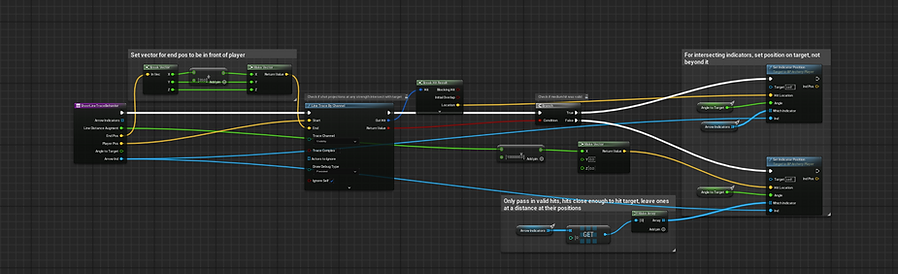
Blueprint for controlling target behavior when hit by an arrow, how to add points based on the ring based on pre-determined launch calculations and distance from the center.

Blueprint for controlling the arrow's velocity based on the strength of the player's flex/duration of holding the shoot button.
Archery Minigame - Dynamic target movement

With every shot, the targets will move to a new position within the player's range in order to prevent memorization and keep gameplay everchanging.
-
~15 hours

Blueprints controlling target movement. The target detects a hit and chooses a random point within the area it was anchored to at the beginning of the game to teleport to.
Archery minigame - turn based system
In this minigame, the players switch turns, each with their own target. This allows each player to be able to focus on their aiming. However, to allow for interaction between multiple players, while it is not their turn, players can flex/use the thumbstick to alter the wind variable slightly, encouraging additional EMG practice and friendly competition.
-
~25 hours

Blueprint for controlling all behaviors related to switching player turns after 3 shots.
Bysen Says minigame - Dynamic beat types
When receiving this minigame, it was purely based on repeating the rhythm played by the gnome. I implemented 3 different chop types to add another level to gameplay. These correspond to 3 different controller buttons and flex strengths. This also helps EMG controller users better fine-tune their muscle responses.
I also implemented several UI and audio additions to communicate to the player which chop type was done.

Video demonstrating the different beat types in action. The gnome and player have different sounds corresponding to the beat types, and the gnome has UI above it indicating which type was played.
-
~15 hours

Blueprint for how the player plays different beat types with different input, plus how gnome/player turns are managed.
Change

Blueprint for how the audio and visual beat type indicators are managed
Bysen Says minigame - AI player implementation
One major addition done during my time on the project was AI player functionality. In the event not all 4 player spots are filled, this auto populates AI controlled players in place of real ones.
To implement this into a rhythm minigame, I used the Bionic Bash Minigame framework to make AI-controlled players that had a weighted probability to play the correct beat type. Then, I randomized an offset that they would play that beat to mimic the imperfect timing a real player would have and allow that to be factored into the scoring.

Video demonstrating one real player (player 1) and three AI players playing simultaneously.
-
~20 hours


Blueprint for calculating the AI player's success rate and which type of beat they will perform, at what time interval.

Blueprint for syncing audio and animations to the AI players with their beat offset time calculations in mind to prevent perfect timing every time and make their behavior more realistic.